
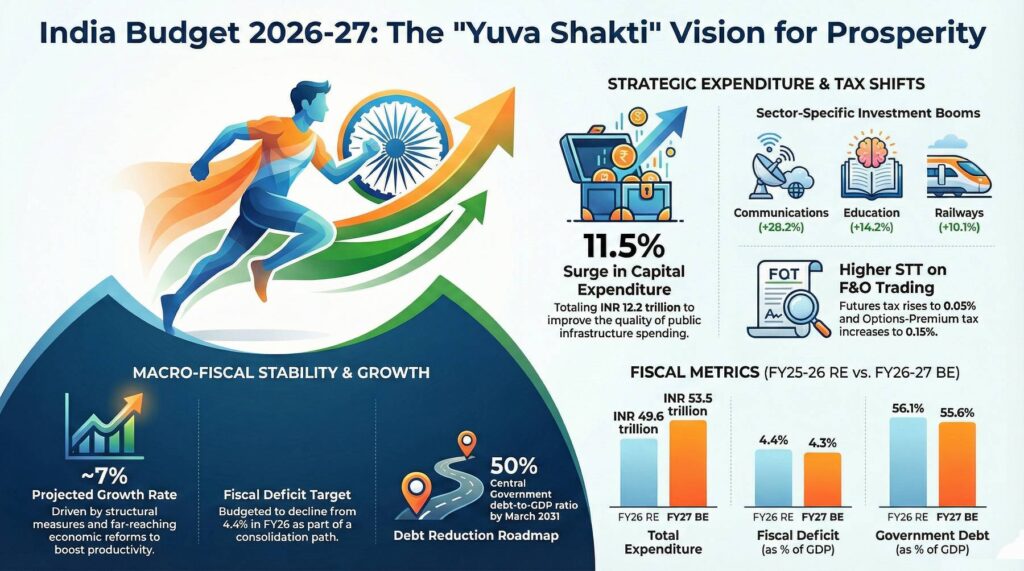
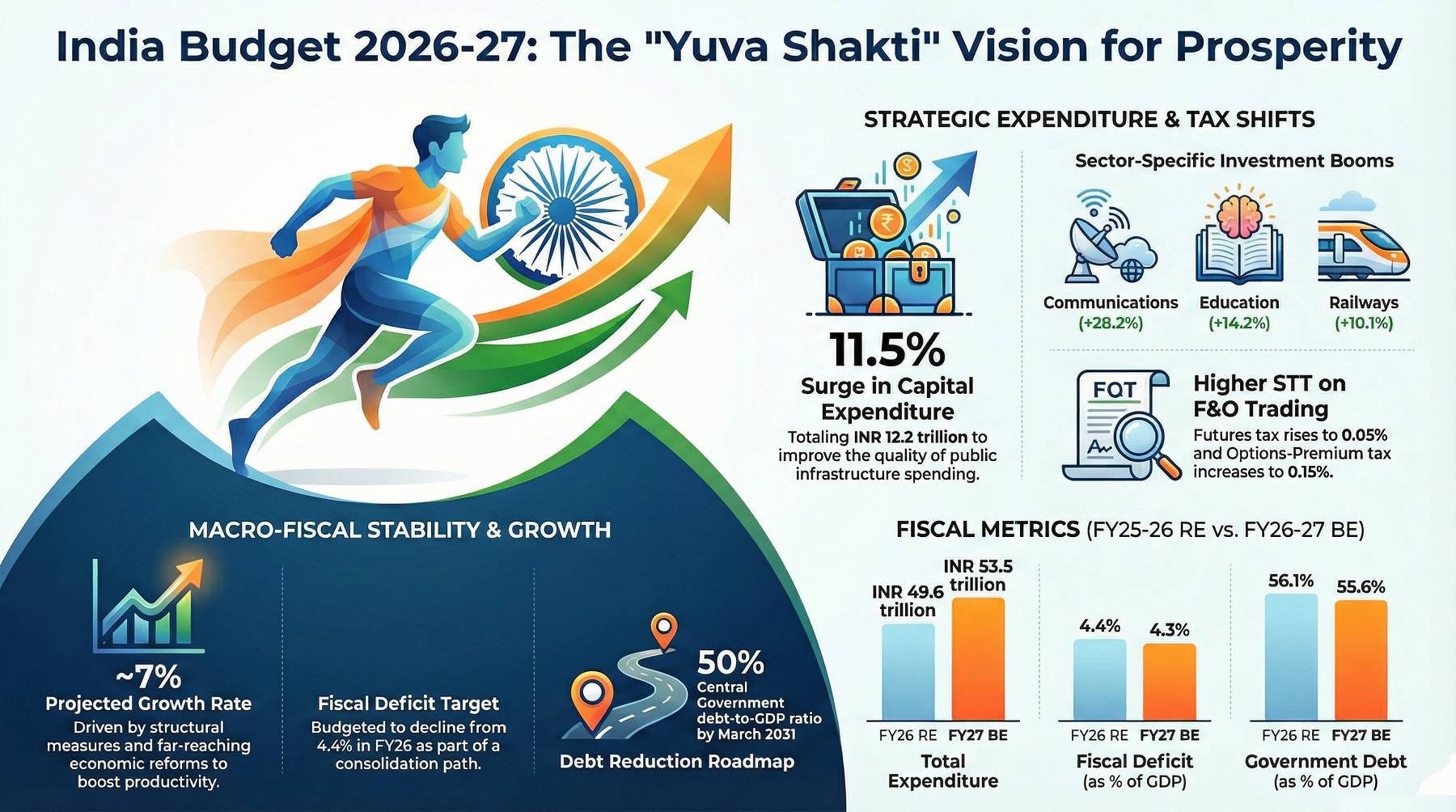
The Union Budget 2026–27 focuses on strengthening India’s growth while ensuring that development benefits every section of society. With a strong emphasis on youth empowerment (“Yuva Shakti”), infrastructure, fiscal discipline, and long-term reforms, the government aims to create more opportunities, boost employment, and enhance economic stability.
Let’s break down the budget into simple points so you know exactly how it may impact your finances and the economy.
🔹 Vision Behind the Budget
The government has structured this budget around three major responsibilities:
- Accelerate economic growth and improve productivity.
- Fulfill the aspirations of citizens by building capacity and creating opportunities.
- Ensure inclusive development so every family and region participates in India’s progress.
👉 Simply put: The focus is on growth with inclusion — not just making the economy bigger, but making it better for everyone.
🔹 Strong Economic Direction
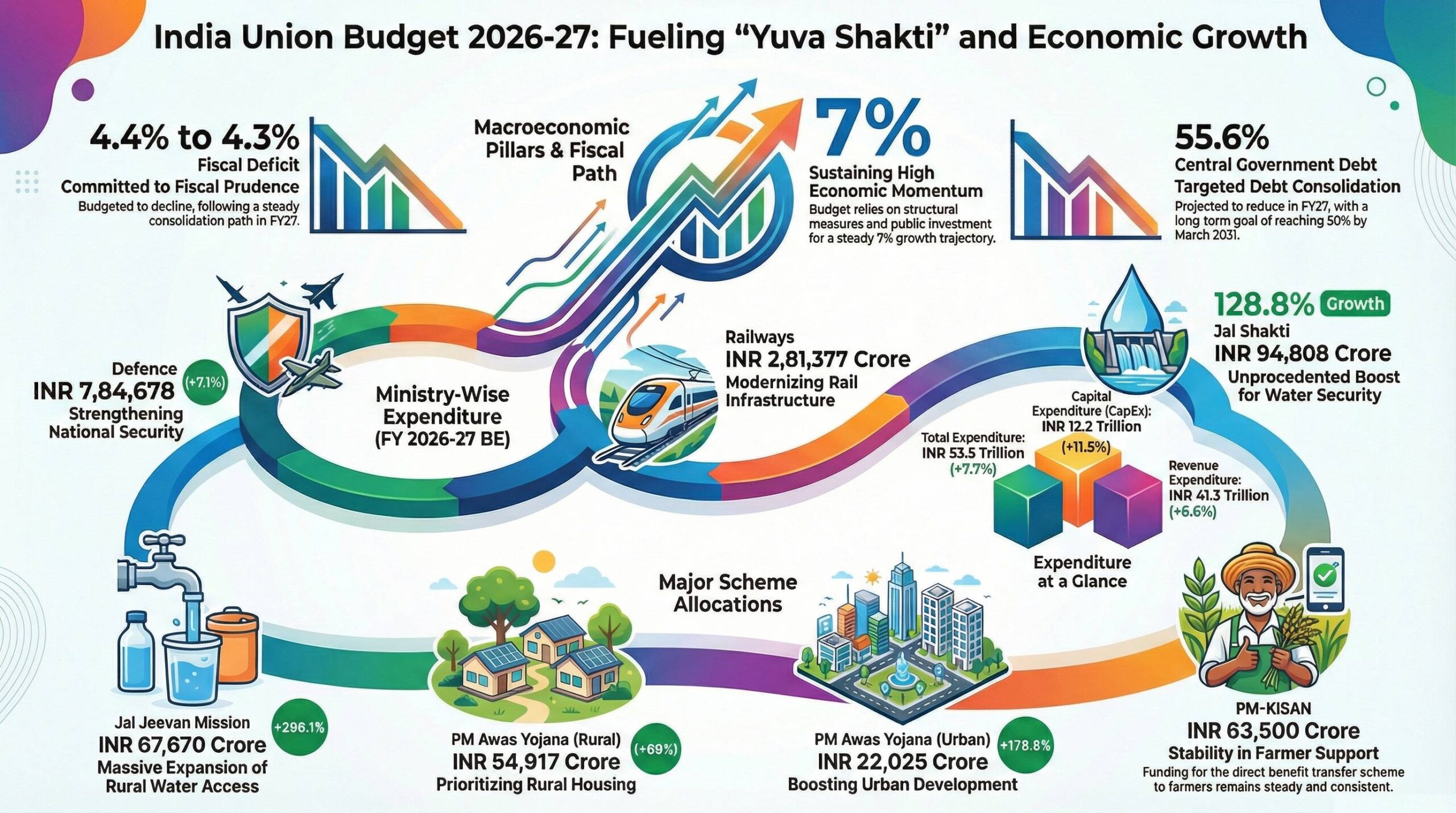
The budget highlights structural reforms aimed at sustaining a growth rate of around 7%, while prioritizing:
- Energy security
- Domestic manufacturing
- Public investment
- Fiscal prudence
- Monetary stability
✅ What this means for you:
A stable economy usually leads to better job creation, improved business opportunities, and stronger investment markets.
🔹 Government Spending: Where the Money Is Going
For FY 2026–27:
- Total expenditure: ₹53.5 trillion
- Capital expenditure: ₹12.2 trillion (higher focus on infrastructure)
- Revenue expenditure: ₹41.3 trillion
👉 Increased capital spending typically results in better roads, railways, housing, and public infrastructure — all of which support long-term growth.
🔹 Fiscal Discipline Remains a Priority
- Fiscal deficit targeted at 4.3% of GDP, slightly lower than the previous year.
- Government debt expected to reduce to 55.6% of GDP, with a long-term target near 50%.
✅ Why this matters:
Lower debt means the government spends less on interest and more on development.
🔹 Taxation Updates You Should Know
- No major changes in tax treatment for individuals and corporates.
- Buybacks will now be taxed as capital gains instead of dividend income.
- Crypto compliance becomes stricter with penalties for incorrect disclosures starting April 2026.
- STT (Securities Transaction Tax) on Futures & Options
- STT on futures increased from 02% → 0.05%.
- STT on options premium increased from 10% → 0.15%.
- STT on exercise of option changed from 13% → 0.15%.
- Impact: Higher trading costs for derivatives. Arbitrage funds and strategies that use futures/options may see a small drag on returns (roughly a few tenths of a percent annually depending on activity).
🔹 Other tax and compliance updates
- ITR filing deadline: Proposed extension to 31 March (with a nominal fee for late filing).
- Buyback tax: Buybacks will be taxed as capital gains (affects how companies and shareholders are taxed on buybacks).
- Sovereign Gold Bonds: Capital gains exemption limited to individuals who buy at issuance and hold to maturity.
- Crypto compliance: Stricter reporting rules with penalties for non-furnishing or incorrect disclosures (effective 1 April 2026).
- Foreign investment limits for certain categories increased (helps attract more overseas capital).
🔹 Tax holiday for cloud and data‑centre providers
The Budget offers a targeted tax holiday for foreign cloud and data‑centre providers that operate data centres in India to serve global customers. Key points you can paste directly:
- Who benefits: Foreign cloud providers using Indian data centres to serve global customers.
- Duration: Tax holiday extended up to 2047, creating a long‑term incentive for hyperscale investments.
- Domestic sales rule: Sales to Indian customers must be routed via an Indian reseller, so domestic revenue remains taxable in India.
- Transfer‑pricing clarity: A 15% safe‑harbour on costs is proposed for related‑party data‑centre services to reduce pricing disputes.
- Why it matters: Encourages large cloud and AI infrastructure builds in India, boosts jobs and digital sovereignty, while protecting India’s tax base for local sales.
Quick advisory line: Firms should review legal text and structure India sales/reseller arrangements carefully; consult a tax advisor for implementation.
🔹 Revenue and Tax Collections
- Gross tax collections projected at ₹44 trillion.
- Income tax and corporate tax continue to be major contributors.
This reflects steady economic activity and improved compliance.
🔹 Key Sector Allocations
Higher spending has been planned for several important ministries:
- Defence: ₹7,84,678 crore
- Railways: ₹2,81,377 crore
- Education: ₹1,39,289 crore
- Health: ₹1,06,530 crore
✅ Impact: Stronger defense, better connectivity, improved education, and enhanced healthcare infrastructure.
🔹 Major Scheme Highlights
- Large allocation for rural housing and drinking water initiatives.
- Continued funding for PM-KISAN.
- Strong push for research, innovation, and digital infrastructure.
- New employment-focused programs introduced.
👉 These initiatives support both rural development and future-ready industries.
⭐ What Does This Budget Mean for the Common Man?
- Expect gradual economic stability.
- Infrastructure growth may improve lifestyle and job opportunities.
- No major tax relief, but also no significant tax burden.
- Long-term reforms indicate a future-focused economy.
✅ Quick Summary
- Budget centers on growth with inclusion.
- Targeted GDP growth around 7%.
- Fiscal deficit reduced — showing financial discipline.
- Higher infrastructure spending for long-term development.
- No major income tax changes.
- Increased compliance in crypto and higher STT for derivatives.
- Strong allocations for defense, railways, education, and health.
- Focus on innovation, employment, and rural development.
Need Help Understanding How This Budget Affects Your Finances?
Whether it’s investments, tax planning, or building long-term wealth — the right guidance can make all the difference.
FinInfinity Team
📧 fininfinity.in@outlook.com
🌐 https://www.fininfinity.in/
💬 WhatsApp: +91 93530 27150
👉 Contact us today to get expert assistance tailored to your financial goals.
