
One of the biggest labour-law reforms in India’s history—how the four labour codes change wages, social security, workplace rules and your take-home pay.
Introduction
On 21 November 2025, the Ministry of Labour & Employment announced that four major labour codes will come into effect across India, rationalising 29 older labour laws. (Press Information Bureau)
This reform aims to simplify compliance for business, expand protection for workers (including gig and platform workers), raise minimum wages, and modernise industrial relations, safety and social security frameworks. (The Economic Times)
In this blog, we’ll unpack:
- What the four codes are
- Key changes for workers & employers
- How salary, provident-fund (PF) and gratuity are impacted
- What you should do next
- The Four Labour Codes & What They Replace
The four new codes are:
- Code on Wages, 2019 – covers wages, minimum wages, bonus, payment of wages.
- Industrial Relations Code, 2020 – covers trade unions, industrial disputes, standing orders, layoffs/retrenchment.
- Code on Social Security, 2020 – covers social security, gig & platform workers, provident fund, maternity, etc.
- Occupational Safety, Health and Working Conditions Code, 2020 (OSHWC) – covers working conditions, occupational safety & health, welfare of workers.
These codes officially replace 29 older Central labour laws. (Ministry of Labour & Employment)
The Government’s press release states: “Four Labour Codes herald transformational change… Codes lay the foundation for a protected, future-ready workforce and resilient industries.” (Press Information Bureau)
- Key Changes & Highlights
🔍 For Employees
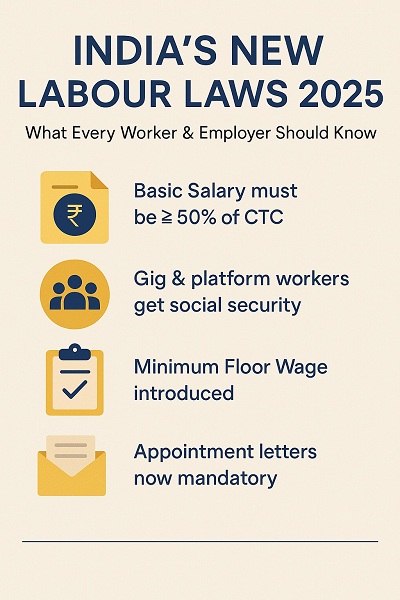
- A national floor minimum wage is now mandated. (www.ndtv.com)
- Formal appointment letters must be issued to workers. (www.ndtv.com)
- Social security coverage extends to gig and platform workers. (The Times of India)
- Women workers get enhanced rights (e.g., night work with safety, equal pay for equal work) under the new codes. (The Economic Times)
- For fixed-term employees, gratuity eligibility may now apply earlier (e.g., after 1 year instead of 5) per recent reports. (The Economic Times)
📊 For Employers
- Simplified compliance: fewer laws, more unified regulation. (BDO India)
- The threshold for mandatory government approval for layoffs is raised (from 100 to 300 workers) in some cases. (Reuters)
- More flexibility in employment contracts and industrial relations. (The Economic Times)
🔧 Other Important Changes
- Working hours flexibility: Up to 12 hours a day, so long as weekly cap (48 hours) is not exceeded. (Reuters)
- Single‐registration and single‐license regime proposed for contractors. (Reuters)
- Impact on Salary, PF & Gratuity
One of the most tangible impacts for salaried employees is the change in how Basic Salary, PF contributions, gratuity and take-home pay will behave under the new codes.
🧾 Why Take-Home Might Drop
The new wage code emphasises that Basic Salary be at least ~50% of CTC (Total Cost to Company) in many cases, thereby raising the PF & gratuity base. This means more of your existing CTC goes to statutory benefits, leaving less as flexible allowances/in-hand pay. (The Times of India)
🔢 Illustrative Example
For an employee with ₹50,000 CTC per month:
| Component | Before New Code | After New Code |
| Basic Salary | ₹15,000 | ₹25,000 (≈50% of CTC) |
| Allowances | ₹35,000 | ₹25,000 |
| Employee PF (12%) | ₹1,800 | ₹3,000 |
| Approximate Take-Home | ~₹48,200 | ~₹47,000 |
(This example is illustrative. Individual company structures may vary.)
🧰 Effects on PF & Gratuity
- Employee PF: Because Basic is higher, your monthly PF deduction (12% of Basic) increases → lower in-hand pay in the short term.
- Employer PF contribution also rises (12% of Basic) which may lead to restructured CTC/allowances by employers.
- Gratuity: With higher Basic, gratuity calculation base goes up → you may receive higher exit benefit while working.
- Fixed‐term and contract workers: In many reports, fixed-term employees become eligible for gratuity earlier (after 1 year) under the new regime. (The Economic Times)
- What You Should Do
For Employees
- Review your salary‐pay slip: Check how Basic and allowances are structured under the new code.
- Understand PF & gratuity changes: Accept a slightly lower take-home if it leads to better long-term benefits.
- Raise emergency savings: Because in-hand pay may fall slightly, ensure you have adequate buffer.
- Stay informed: Check state‐wise notifications since many rules will vary by state.
For Employers
- Re‐structure salary templates: Ensure Basic is in line with 50% requirement and PF/gratuity costs are accounted for.
- Update employment contracts & appointment letters: Must comply with new codes (e.g., formal letters, gig worker coverage, etc.).
- Monitor implementation rules: While codes are in force, many state‐specific rules/notifications are still being framed. (BDO India)
- Communicate clearly to employees: Especially about changes in take‐home, PF, gratuity and benefits.
- Summary & Final Thoughts
The implementation of the four labour codes from 21 November 2025 marks a major milestone in India’s labour law landscape. (Press Information Bureau)
For workers, the reform means better formalisation, social security, clearer rights and higher long‐term benefits.
For employers, it means simplified and more consistent labour regulation — but also higher benefits cost and change in salary mechanics.
While many may experience a slight drop in take-home pay, the new law sets them up for stronger long‐term retirement, gratuity and social security benefits.
Staying proactive, well-informed and compliant will help individuals and organisations make the most of this landmark reform.
Reference List
- Government of India, Press Release: “Government makes the Four Labour Codes effective” — Press Information Bureau (21 Nov 2025). (Press Information Bureau)
- “Four Labour Codes come into force: Who benefits, what changes …” — The Economic Times. (The Economic Times)
- “Minimum Wage, Health Checkup, WFH And More: 12 Changes In Labour Rules Every Employee Must Know” — NDTV. (www.ndtv.com)
- “Explained: How new labour laws could hit your take-home salary, increase your provident fund & gratuity contributions” — Times of India. (The Times of India)
- “India enforces four new labour codes in major overhaul of worker rules” — Reuters. (Reuters)
